EduData
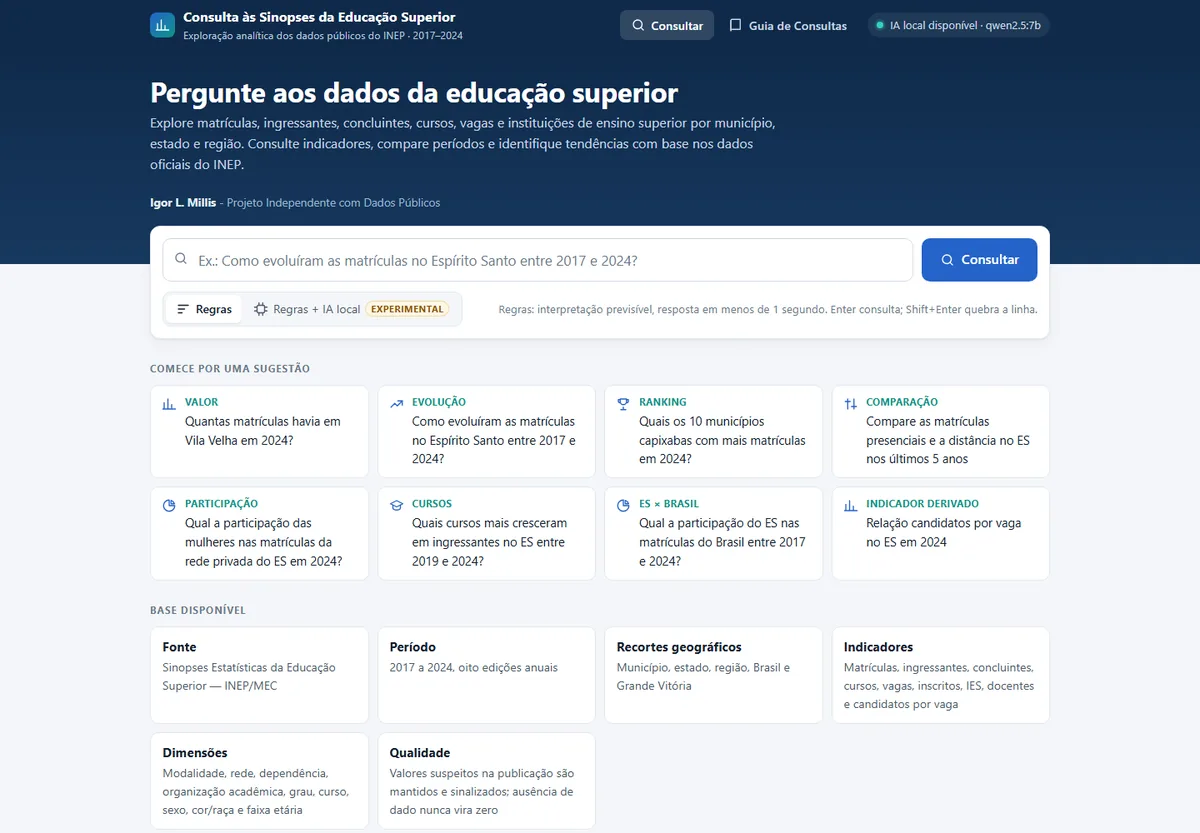
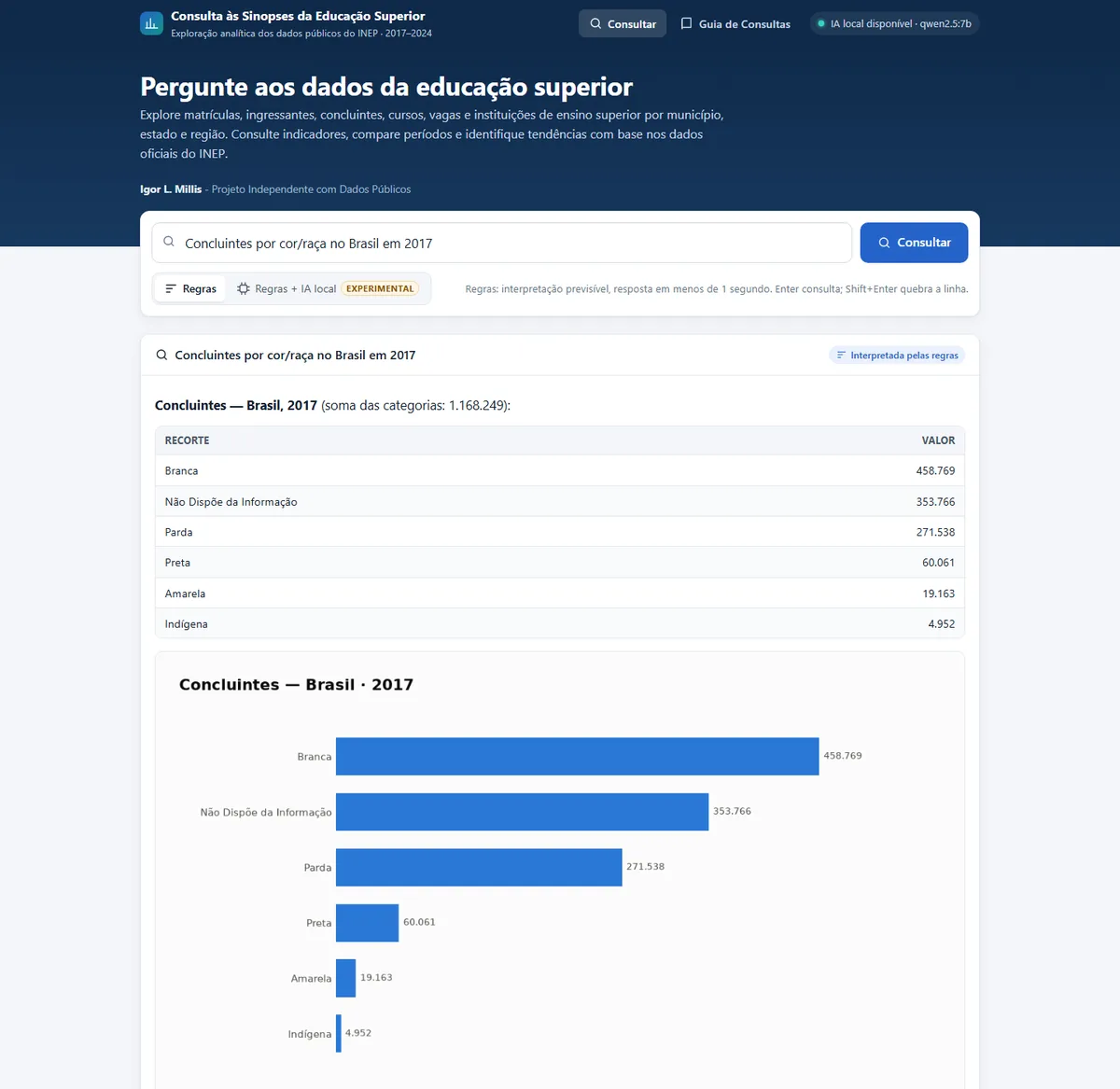
Ask questions in Portuguese about eight editions of Brazil's higher-education statistics. Numbers come from the database — never from a model.
Try the live demo ↗ free tier: the first visit may take ~1 min to wake the server
- source
- INEP/MEC — Sinopses Estatísticas da Educação Superior
- period
- 2017–2024 (8 annual editions)
- storage
- DuckDB (~4.5 GB) · Parquet staging
- runtime
- local (Python 3.12 · Windows) or online (Render · rules only · 105 MB slim database)
- llm
- Ollama + Qwen2.5 7B (optional)
- status
- v1 delivered · independent project
- live demo
- consulta-sinopses.onrender.com ↗
Public data, unfriendly format
The INEP Synopses are the official yearly statistics of Brazilian higher education — but they ship as hundreds of spreadsheet tabs per year, with layouts that change between editions. Answering “how did enrollment evolve in Espírito Santo?” means opening workbooks, finding the right tab and hoping the columns mean the same thing as last year.
Goal: a tool where anyone can ask in plain Portuguese and get a number that is computed, traceable and honest about what the data does not contain.
Seven layers from ZIP to answer
Raw files are never touched. Every value in the core keeps the tab and cell of the original INEP spreadsheet it came from. Select a stage:
Question → query → SQL
A rule-based interpreter with a semantic catalog turns the question into a structured Consulta. That JSON query is validated against the catalog and the database, then compiled into parameterized SQL executed on a read-only connection. Rankings, growth and shares are computed in Python afterwards.
Replay real questions from the project's gold set:
Queries are taken from tests/gold_interpretacoes.jsonl. SQL reproduced from the query planner in motor/consultas.py — a replay, not a live database.
Where a local LLM helps — and where it doesn't
A local model (Ollama, on CPU) can help interpret questions the rules don't recognize. It is held to the same JSON query structure: it returns names, never SQL or numbers. The decision to keep it optional came from measuring it on 40 paraphrased and unseen questions:
| interpreter | paraphrases /24 | unseen control /16 | total /40 | mean time |
|---|---|---|---|---|
| Rules | 24* | 14 | 38* | 0.2 s |
| LLM 3B alone | 13 | 8 | 21 | 11 s |
| LLM 7B alone | 14 | 13 | 27 | 21–23 s |
| Hybrid (rules + 7B) | 24* | 14 | 38* | 0.5–1 s |
* Rules were adjusted after seeing paraphrase failures, so 24/24 does not measure generalization; the unseen control set does. Source: _arquitetura/02_decisoes.md (D17).
Decision: rules by default; hybrid mode with the 7B model as an opt-in, with a mandatory warning to check the interpretation. No model alone matched the rules — the 7B made far fewer errors than the 3B (27 vs 21 of 40), so when the model is used, accuracy wins over latency.
Honesty rules, enforced in code
- Nothing is silently fixed. Publication inconsistencies (occurrences Q01–Q13) stay as published, get a
suspeitostatus and are cited in answers. - Absence ≠ zero. Missing rows never become zeros; shares without a numerator are undefined.
- Ratios are ratios of sums — never averages of ratios.
- Layered SQL security: read-only connection, SELECT/WITH only, table allow-list, no file access, 60 s timeout, 5,000-row limit, every query logged.
- Reversible operations: database compaction by copy-validate-swap (5.11 → 4.48 GB), proven equivalent on all 61 gold answers.
Charts that state the conclusion
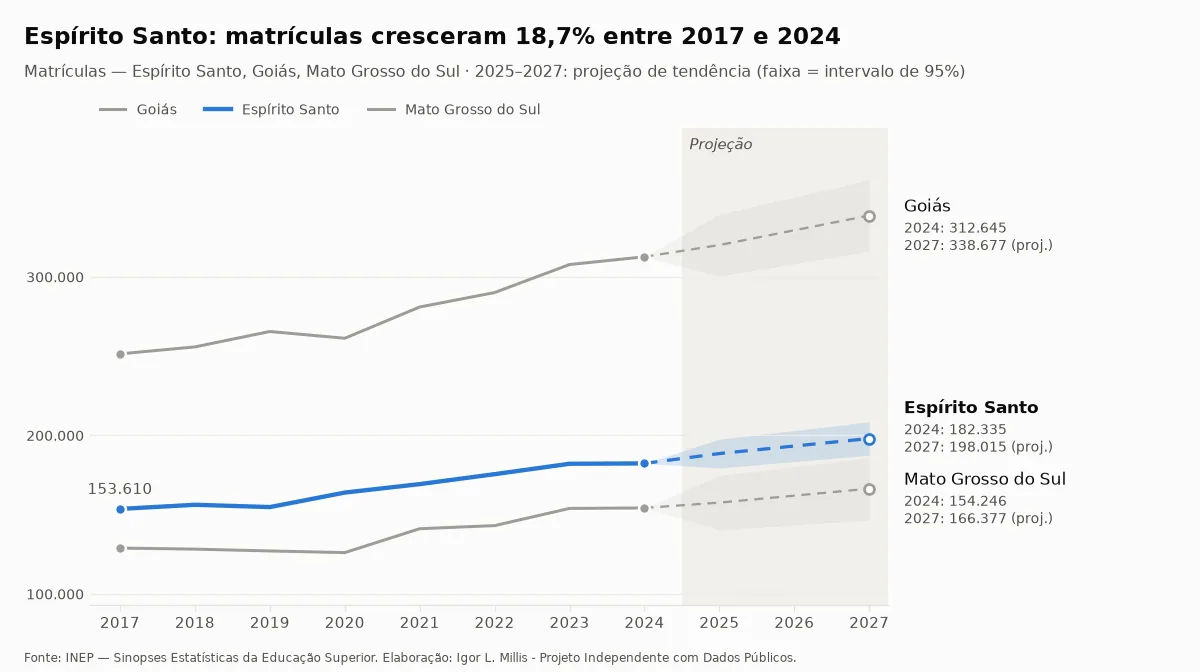
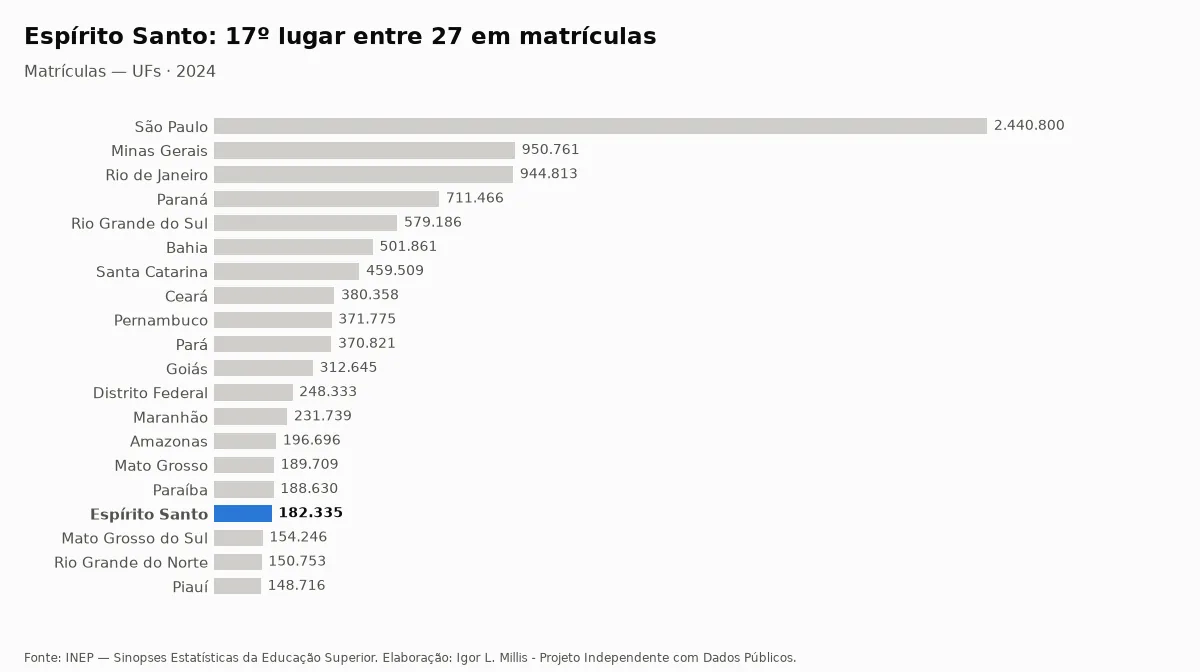
Titles assert the finding, only Espírito Santo gets color, values are labeled at the line end, and annual series get a 3-year linear-trend projection with a 95% prediction interval — clearly marked as statistical extrapolation, not INEP data.
Known limitations
- Disability, quotas, financing, shift, nationality and faculty degree exist in the base but are not yet exposed by the engine.
- The Synopses publish no cohort dropout or completion rates; distance-learning courses, seats and applicants exist only at the national level.
- The rule interpreter covers the question forms documented in its guide; the local LLM is experimental (27/40 alone).
- The database (~4.5 GB) is not in the repository — it is rebuilt from the public ZIPs (~3 h) using the manifest with MD5 checksums.
Independent project with public data — not an official product of any institution.